English
 Język Polski

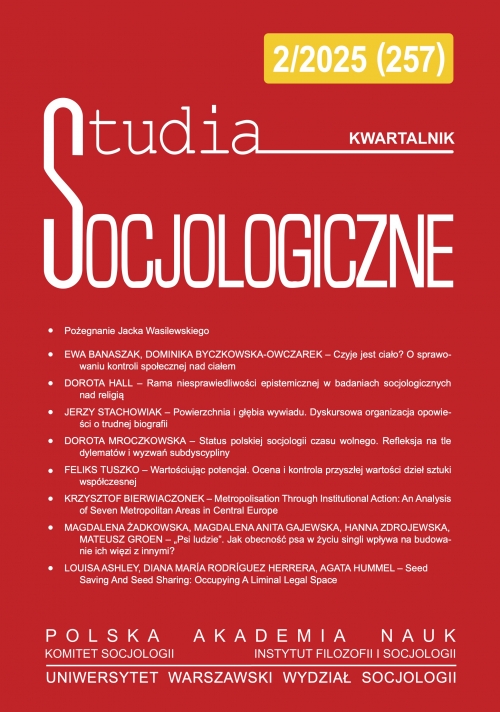
Rama niesprawiedliwości epistemicznej w badaniach socjologicznych nad religią
DOI:
https://doi.org/10.24425/sts.2025.154896Słowa kluczowe:
socjologia religii, Kościół rzymskokatolicki, niesprawiedliwość epistemiczna, strukturalna ignorancjaAbstrakt
Artykuł przedstawia możliwości zastosowania ramy niesprawiedliwości epistemicznej w badaniach socjologicznych nad religią. Przybliża on koncepcję niesprawiedliwości epistemicznej w wersji przedstawionej przez Fricker (2007) oraz późniejsze rozwinięcia tej koncepcji, inspirowane zwłaszcza studiami nad płcią i krytycznymi studiami nad rasą. Artykuł pokazuje również, w jaki sposób do tej pory uwzględniano kwestię niesprawiedliwości epistemicznej w refleksji akademickiej nad religią. Mówi o tym, dlaczego wykorzystanie ramy niesprawiedliwości epistemicznej jest szczególnie obiecujące dla badań socjologicznych nad religią, sugeruje tematy badawcze, które mogłyby stanowić punkt wyjścia do zarysowania „geografii epistemicznej” religii w Polsce, i wyszczególnia możliwe pytania badawcze.
Bibliografia
Abu-Lughod, L. (2002). Do Muslim Women Really Need Saving? American Anthropologist, 104(3), 783-790. [https://doi.org/10.1525/aa.2002.104.3.783](https://doi.org/10.1525/aa.2002.104.3.783)
Alcoff, L. M. (1991-1992). The Problem of Speaking for Others. Cultural Critique, 20, 5-32. [https://doi.org/10.2307/1354221](https://doi.org/10.2307/1354221)
Alcoff, L. M. (2007). Epistemologies of Ignorance: Three Types. W: S. Sullivan, N. Tuana (red.), Race and Epistemologies of Ignorance (s. 39-58). SUNY Press.
Altglas, V., Wood, M. (2018). Introduction: An Epistemology for the Sociology of Religion. W: V. Altglas, M. Wood (red.), Bringing Back the Social into the Sociology of Religion (s. 1-34). Brill.
Anderson, E. (2011). The Imperative of Integration. Princeton University Press.
Anderson, E. (2012). Epistemic Justice as a Virtue of Social Institutions. Social Epistemology, 26(2), 163-173. [https://doi.org/10.1080/02691728.2011.652211](https://doi.org/10.1080/02691728.2011.652211)
Anderson, P. S. (2012). Re-Envisioning Gender in Philosophy of Religion: Reason, Love, and Epistemic Locatedness. Ashgate.
Asad, T. (1993). Genealogies of Religion: Discipline and Reasons of Power in Christianity and Islam. Johns Hopkins University Press.
Ayotte, K. J., Husain, M. E. (2005). Securing Afghan Women: Neocolonialism, Epistemic Violence, and the Rhetoric of the Veil. NWSA Journal, 17(3), 112-133.
Berenstain, N. (2016). Epistemic Exploitation. Ergo: An Open Access Journal of Philosophy, 3(22), 569-590. [http://dx.doi.org/10.3998/ergo.12405314.0003.022](http://dx.doi.org/10.3998/ergo.12405314.0003.022)
Beste, J. (2020). Justice for Children: New Directions for Responding to the Catholic Clergy Abuse Crisis. Journal of the Society of Christian Ethics, 40(2), 345-362. [https://doi.org/10.5840/jsce202111237](https://doi.org/10.5840/jsce202111237)
Beauchamp, G. (2023). Epistemic Injustice as a Ground for Religious Education in Public Schools. Religious Education, 118(2), 119-32. [https://doi.org/10.1080/00344087.2023.2181916](https://doi.org/10.1080/00344087.2023.2181916)
Beckford, J. A. (2006). Teoria społeczna a religia (M. Kunz, T. Kunz, tłum.). Nomos.
bell hooks (1990). Yearning: Race, Gender, and Cultural Politics. South End Press.
Casanova, J. (2005). Religie publiczne w nowoczesnym świecie (T. Kunz, tłum.). Nomos.
Code, L. (1991). What Can She Know? Feminist Theory and Construction of Knowledge. Cornell University Press.
Code, L. (1993). Taking Subjectivity into Account. W: L. Alcoff, E. Potter (red.), Feminist Epistemologies (s. 15-48). Routledge.
Code, L. (2007). The Power of Ignorance. W: S. Sullivan, N. Tuana (red.), Race and Epistemologies of Ignorance (s. 213-229). SUNY Press.
Collins, P. H. (1990). Black Feminist Thought: Knowledge, Consciousness, and the Politics of Empowerment. Unwin Hyman.
Crenshaw, K. W. (1991). Mapping the Margins: Intersectionality, Identity Politics, and Violence against Women of Color. Stanford Law Review, 43(6): 1241-1299. [https://doi.org/10.2307/1229039](https://doi.org/10.2307/1229039)
Czyżewski, M. (2015). Społeczeństwo niewiedzy i socjologia niewiedzy. W: A. Jabłoński, J. Szymczyk, M. Zemło (red.), Kreowanie społeczeństwa niewiedzy (s. 237-254). Wydawnictwo KUL.
Czyżewski, M., Dunin, K., Piotrowski, A. (red.) (1991). Cudze problemy: o ważności tego, co nieważne. Analiza dyskursu publicznego w Polsce. Ośrodek Badań Społecznych.
De Cruz, H. (2020). Philosophy of Religion From the Margins: A Theoretical Analysis and Focus Group Study. W: B. Hereth, K. Timpe (red.), The Lost Sheep in Philosophy of Religion: New Perspectives on Disability, Gender, Race, and Animals (s. 31-54). Routledge.
Dębińska, M. (2020). Transpłciowość w Polsce. Wytwarzanie kategorii. Wydawnictwo Instytutu Archeologii i Etnologii PAN.
Dotson, K. (2011). Tracking Epistemic Violence, Tracking Practices of Silencing. Hypatia: A Journal of Feminist Philosophy, 26(2), 236-257. [https://doi.org/10.1111/j.1527-2001.2011.01177.x](https://doi.org/10.1111/j.1527-2001.2011.01177.x)
Dotson, K. (2012). A Cautionary Tale: On Limiting Epistemic Oppression. Frontiers: A Journal of Women Studies, 33(1), 24-47. [https://doi.org/10.1353/fro.2012.a472779](https://doi.org/10.1353/fro.2012.a472779)
Drozdowski, R. (2023). Dlaczego potrzebujemy socjologii (nie)wiedzy? Roczniki Nauk Społecznych, 15(1), 69-80. [https://doi.org/10.18290/rns2023.0008](https://doi.org/10.18290/rns2023.0008)
Du Bois, W. E. B. (1996). The Souls of Black Folk. Penguin Classics.
Fanon, F. (2020). Czarna skóra, białe maski (U. Kropiwiec, tłum.). Karakter.
Fricker, M. (2007). Epistemic Injustice: Power and the Ethics of Knowing. Oxford University Press.
Fricker, M. (2017). Evolving Concepts of Epistemic Injustice. W: I. J. Kidd, J. Medina, G. Pohlhaus, Jr. (red.), The Routledge Handbook of Epistemic Injustice (s. 53-60). Routledge.
Fundacja Wolność od Religii. (2022). Mapa nierówności w szkole. Raport dostępny na: [https://rownoscwszkole.pl/images/mapa/mapa-nierownosci-w-szkole-2022.pdf](https://rownoscwszkole.pl/images/mapa/mapa-nierownosci-w-szkole-2022.pdf)
Goldstein, W. S., Boer, R., Boyarin, J. (2013). Editorial. Critical Research on Religion, 1(1), 3-8. [https://doi.org/10.1177/2050303213476471](https://doi.org/10.1177/2050303213476471)
Gott, C. K. (2022). Experience, Identity and Epistemic Injustice within Ireland's Madelaine Laundries. Bloomsbury Academic.
Halemba, A. (2021). O potrzebie antropologicznych badań organizacyjnego wymiaru religii. Studia Religiologica, 54(1), 1-17. [https://doi.org/10.4467/20844077SR.21.001.13925](https://www.google.com/search?q=https://doi.org/10.4467/20844077SR.21.001.13925)
Hall, D. (2016). W poszukiwaniu miejsca. Chrześcijanie LGBT w Polsce. Wydawnictwo IFIS PAN.
Hall, D. (2020). Autorefleksja i usytuowanie badawcze w socjologicznych studiach nad religią. Studia Socjologiczne, 238(3), 161-186. [https://doi.org/10.24425/sts.2020.132474](https://www.google.com/search?q=https://doi.org/10.24425/sts.2020.132474)
Hall, D. (2025). The Debate on Homosexuality in Poland during the 2000s and the Lord-boor Game. W: A. Kościańska, A. Kurimay, K. Lišková, H. Z. Renkin (red.), The Routledge Handbook of Sexuality in East Central Europe (s. 285-293). Routledge.
Hall, D., Kołodziejska, M. (2021). COVID-19 Pandemic, Mediatization and the Polish Sociology of Religion. Polish Sociological Review, 213(1), 123-137. [https://doi.org/10.26412/psr213.07](https://www.google.com/search?q=https://doi.org/10.26412/psr213.07)
Hall, D., Kołodziejska, M., Radde-Antweiler, K. (2024). Minority Churches as Media Settlers: Negotiating Deep Mediatization. Routledge.
Haraway, D. (2008). Wiedze usytuowane: kwestia nauki w feminizmie i przywilej częściowej/ograniczonej perspektywy (A. Czarnacka, tłum.). Biblioteka Online Think Tanku Feministycznego. Dostępne na: [http://www.ekologiasztuka.pl/pdf/haraway_1988.pdf](https://www.google.com/search?q=http://www.ekologiasztuka.pl/pdf/haraway_1988.pdf)
Harding, S. (1991). Whose Science? Whose Knowledge? Thinking from Women's Lives. Cornell University Press.
Hartsock, N. (1983). Money, Sex, and Power: Toward a Feminist Historical Materialism. Longman.
Hereth, B., Timpe. K. (red.). (2020). The Lost Sheep in Philosophy of Religion: New Perspectives on Disability, Gender, Race, and Animals. Routledge.
Hornsby, J. Langton, R. (1998). Free speech and illocution. Legal Theory, 4(1), 21-37. [https://doi.org/10.1017/S1352325200000902](https://doi.org/10.1017/S1352325200000902)
Kidd, I. J. (2017). Epistemic Injustice and Religion. W: I. J. Kidd, J. Medina, G. Pohlhaus, Jr. (red.), The Routledge Handbook of Epistemic Injustice (s. 386-396). Routledge.
Kidd, I. J., Medina, J., Pohlhaus, Jr., G. (red.). (2017). The Routledge Handbook of Epistemic Injustice. Routledge.
Kościelniak, M. (2024). Aborcja i demokracja. Przeciw-historia Polski 1956-1993. Wydawnictwo Krytyki Politycznej.
Langton, R. (2010). Review of Epistemic Injustice: Power and the Ethics of Knowing. Hypatia: A Journal of Feminist Philosophy, 25(2), 459-464. [https://doi.org/10.1111/j.1527-2001.2010.01098.x](https://doi.org/10.1111/j.1527-2001.2010.01098.x)
Lauwers, A. S. (2023). Religion, Secularity, Culture? Investigating Christian Privilege in Western Europe. Ethnicities, 23(3), 403-425. [https://doi.org/10.1177/14687968221106185](https://doi.org/10.1177/14687968221106185)
Lee, J. Y. (2021). Anticipatory Epistemic Injustice. Social Epistemology, 35(6), 564-576. [https://doi.org/10.1080/02691728.2021.1924306](https://doi.org/10.1080/02691728.2021.1924306)
Lloyd, G. (1984). The Male of Reason: "Male" and "Female" in Western Philosophy. University of Minnesota Press.
Lougheed, Kirk. 2020. Epistemic Injustice and Religious Experience. W: B. Hereth, K. Timpe (red.), The Lost Sheep in Philosophy of Religion: New Perspectives on Disability, Gender, Race, and Animals (s. 79-96). Routledge.
Lynch, T. (2022). Epistemic Injustice and the Veil: Islam, Vulnerability, and the Task of Historical Revisionism. Culture and Religion, 21(3), 280-297. [https://doi.org/10.1080/14755610.2022.2115524](https://www.google.com/search?q=https://doi.org/10.1080/14755610.2022.2115524)
Maitra, I. (2010). The Nature of Epistemic Injustice. Philosophical Books, 51(4), 195-211. [https://doi.org/10.1111/j.1468-0149.2010.00511.x](https://doi.org/10.1111/j.1468-0149.2010.00511.x)
Mandes, S. (2020). Clerical Sexual Abuse in an Illiberal State: The Case of Poland. Journal of Church and State, 62(1), 110-134. [https://doi.org/10.1093/jcs/csz089](https://doi.org/10.1093/jcs/csz089)
Markowitz, L., Puchner, L. (2018). Structural Ignorance of Christian Privilege. International Journal of Qualitative Studies in Education, 31(10), 877-894. [https://doi.org/10.1080/09518398.2018.1506180](https://www.google.com/search?q=https://doi.org/10.1080/09518398.2018.1506180)
McGoey, L. (2012). The Logic of Strategic Ignorance. British Journal of Sociology, 63(3), 553-576. [https://doi.org/10.1111/j.1468-4446.2012.01424.x](https://doi.org/10.1111/j.1468-4446.2012.01424.x)
McHugh, N. A. (2017). Epistemic Communities and Institutions. W: I. J. Kidd, J. Medina, G. Pohlhaus, Jr. (red.), The Routledge Handbook of Epistemic Injustice (s. 270-278). Routledge.
McKinnon, R. (2017). Allies Behaving Badly: Gaslighting as Epistemic Injustice. W: I. J. Kidd, J. Medina, G. Pohlhaus, Jr. (red.), The Routledge Handbook of Epistemic Injustice (s. 167-174). Routledge.
Medina, J. (2013). The Epistemology of Resistance: Gender and Racial Oppression, Epistemic Injustice, and Resistant Imaginations. Oxford University Press.
Medina, J. (2017). Varieties of hermeneutical Injustice. W: I. J. Kidd, J. Medina, G. Pohlhaus, Jr. (red.), The Routledge Handbook of Epistemic Injustice (s. 41-52). Routledge.
Medina, J. (2023). The Epistemology of Protest: Silencing, Epistemic Activism, and the Communicative Life of Resistance. Oxford University Press.
Mica, A., Horolets, A., Pawlak, M., Kubicki, P. (2021). Ignorance and Change: Anticipatory Knowledge and the European Refugee Crisis. Routledge.
Mills, C. (1997). The Racial Contract. Cornell University Press.
Mills, C. (2007). White Ignorance. W: S. Sullivan, N. Tuana (red.), Race and Epistemologies of Ignorance (s. 11-38). SUNY Press.
Mishtal, J. (2015). The Politics of Morality: The Church, the State, and Reproductive Rights in Postsocialist Poland. Ohio University Press.
Moraga, C., Anzaldúa, G. (red.). (1981). This Bridge Called My Back: Writings by Radical Women of Color. Persephone.
Moyaert, M. 2019. Interreligious Learning, Ricoeur, and the Problem of Testimonial and Hermeneutical Injustice. Journal of Nationalism, Memory & Language Politics, 13(2), 205-223. [https://doi.org/10.2478/jnmlp-2019-0014](https://doi.org/10.2478/jnmlp-2019-0014)
Neumann-Karpińska, A. (2023). Niesprawiedliwość epistemiczna a możliwość śledzenia trajektorii cierpienia w wywiadzie autobiograficznym. Etyczny namysł nad metodą. Kultura Społeczeństwo Edukacja, 2(24), 321-335. [https://doi.org/10.14746/kse.2023.24.2.18](https://doi.org/10.14746/kse.2023.24.2.18)
Ortega, M. (2006). Being Lovingly, Knowingly Ignorant: White Feminism and Women of Color. Hypatia: A Journal of Feminist Philosophy, 21(3), 56-74. [https://doi.org/10.1111/j.1527-2001.2006.tb01113.x](https://doi.org/10.1111/j.1527-2001.2006.tb01113.x)
Panchuk, M. (2020). Distorting Concepts, Obscured Experiences: Hermeneutical Injustice in Religious Trauma and Spiritual Violence. Hypatia: A Journal of Feminist Philosophy, 35(4), 607-625. [https://doi.org/10.1017/hyp.2020.32](https://doi.org/10.1017/hyp.2020.32)
Panchuk, M., Rea, M. (red.). (2020). Voices from the Edge: Centering Marginalized Perspectives in Analytic Theology. Oxford University Press.
Pasieka, A. (2015). Hierarchy and Pluralism: Living Religious Difference in Catholic Poland. Palgrave Macmillan.
Pohlhaus, Jr., G. (2012). Relational Knowing and Epistemic Injustice: Toward a Theory of Willful Hermeneutical Ignorance. Hypatia: A Journal of Feminist Philosophy, 27(4), 715-735.
Rejowska, A. (2023). Humanist Marriage Ceremonies in Poland: Re-enchantment and Four Social Constructions of the Sacred. Religion, 54(1), 40-61. [https://doi.org/10.1080/0048721X.2023.2277022](https://www.google.com/search?q=https://doi.org/10.1080/0048721X.2023.2277022)
Rekis, J. (2023). Religious Identity and Epistemic Injustice: An Intersectional Account. Hypatia: A Journal of Feminist Philosophy, 38(4), 779-800. [https://doi.org/10.1017/hyp.2023.86](https://www.google.com/search?q=https://doi.org/10.1017/hyp.2023.86)
Ross, S. A. (2019). Feminist Theology and the Clergy Sexual Abuse Crisis. Theological Studies, 80(3), 632-652. [https://doi.org/10.1177/0040563919857186](https://doi.org/10.1177/0040563919857186)
Sekerdej, K., Pasieka, A. (2013). Researching the Dominant Religion: Anthropology at Home and Methodological Catholicism. Method and Theory in the Study of Religion, 25, 53-77.
Smoczyński, R., Zarycki, T. (2017). Totem inteligencki. Arystokracja, szlachta i ziemiaństwo w polskiej przestrzeni społecznej. Wydawnictwo Naukowe Scholar.
Spivak, G. C. (2011). Czy podporządkowani inni mogą przemówić? (E. Majewska, tłum.). Krytyka Polityczna, 24/25, 196-239.
Stones, A., Fraser-Pearce, J. (2022). Is There a Place for Bildung in Preparing Religious Education Teachers to Support and Promote Epistemic Justice in Their Classrooms? Journal of Religious Education, 70(3), 367-382. [https://doi.org/10.1007/s40839-022-00187-5](https://www.google.com/search?q=https://doi.org/10.1007/s40839-022-00187-5)
Strhan, A., Shillitoe, R. (2022). The Experiences of Non-Religious Children in Religious Education. Journal of Religious Education, 70(3), 261-272. [https://doi.org/10.1007/s40839-022-00180-y](https://doi.org/10.1007/s40839-022-00180-y)
Sullivan, S. (2006). Revealing Whiteness: The Unconscious Habits of Racial Privilege. Indiana University Press.
Sullivan, S. (2007). White Ignorance and Colonial Oppression: Or, Why I Know So Little about Puerto Rico. W: S. Sullivan, N. Tuana (red.), Race and Epistemologies of Ignorance (s. 153-172). SUNY Press.
Tobin, T. (2016). Spiritual Violence, Gender, and Sexuality: Implications for Seeking and Dwelling among Some Catholic Women and LGBT Catholics. W: P. J. Rossi (red.), Seekers and Dwellers: Plurality and Wholeness in a Time of Secularity (s. 133-166). The Council for Research in Values and Philosophy.
Tuana, N. (2006). The Speculum of Ignorance: The Women's Health Movement and Epistemologies of Ignorance. Hypatia: A Journal of Feminist Philosophy, 21(3), 1-19. [https://doi.org/10.1111/j.1527-2001.2006.tb01110.x](https://doi.org/10.1111/j.1527-2001.2006.tb01110.x)
Tuana, N. (2017). Feminist Epistemology: The Subject of Knowledge. W: I. J. Kidd, J. Medina, G. Pohlhaus, Jr. (red.), The Routledge Handbook of Epistemic Injustice (s. 125-138). Routledge.
Waligórska, M. (2023). Cross Purposes: Catholicism and the Political Imagination in Poland. Cambridge University Press.
Zarycki, T., Smoczyński, R., Warczok, T. (2022). Cultural Citizenship without State: Historical Roots of the Modern Polish Citizenship Model. Theory and Society, 51, 269-301. [https://doi.org/10.1007/s11186-021-09465-x](https://doi.org/10.1007/s11186-021-09465-x)
Zielińska, K. (2018). W walce o hegemonię? Religia w polskiej sferze publicznej na przykładzie debat sejmowych. Wydawnictwo Uniwersytetu Jagiellońskiego.
Zubrzycki, G. (2006). The Crosses of Auschwitz: Nationalism and Religion in Post-communist Poland. The University of Chicago Press.
Pobrania
Opublikowane
Jak cytować
Numer
Dział
Licencja
Prawa autorskie (c) 2025 Studia Socjologiczne

Utwór dostępny jest na licencji Creative Commons Uznanie autorstwa – Użycie niekomercyjne – Bez utworów zależnych 4.0 Międzynarodowe.