English
 Język Polski

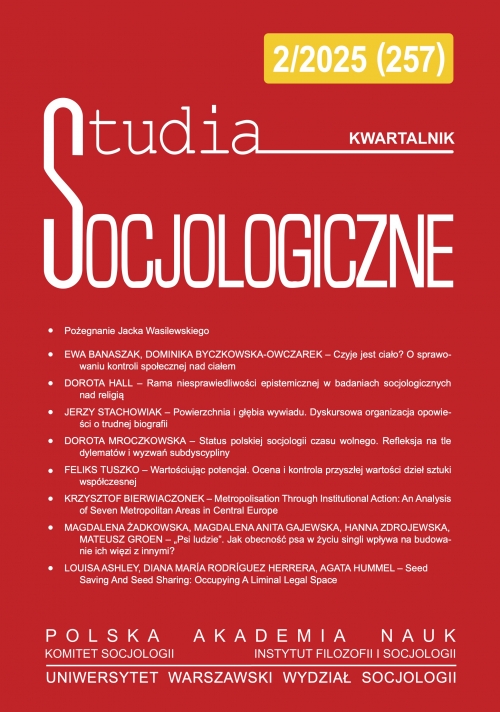
Wartościując potencjał. Ocena i kontrola przyszłej wartości dzieł sztuki współczesnej
DOI:
https://doi.org/10.24425/sts.2025.154899Słowa kluczowe:
wartościowanie, rynek sztuki, socjologia pragmatyczna, assetyzacja, BoltanskiAbstrakt
W literaturze poświęconej wartościowaniu sztuki dominuje przekonanie, że dzieła sztuki są oceniane głównie przez pryzmat ich historii – ich obecna wartość wynika z wcześniejszych ocen, interpretacji oraz pozycji twórcy w polu artystycznym. Powstaje zatem pytanie: jak przebiega proces wartościowania dzieł bez wyraźnej przeszłości – dzieł nowych, często jeszcze nieukończonych, stworzonych przez młode i względnie nieznane osoby artystyczne? Wykorzystując perspektywę socjologii pragmatycznej, argumentuję, że takie dzieła są wartościowane przede wszystkim przez pryzmat ich potencjału – tego, czym mogą się stać w przyszłości. Na podstawie szeroko zakrojonych badań nad wartościowaniem sztuki, przeprowadzonych w Polsce i Stanach Zjednoczonych, pokazuję, jak niepewność – z natury rzeczy wpisana w wartościowanie nieznanej przyszłości – jest zmniejszana przez praktyki i urządzenia (1) kształtujące i uspójniające oczekiwania wobec przyszłości oraz (2) wiążące przyszłość z teraźniejszością.
Bibliografia
Adam, B., Groves, C. (2007). Future matters: Action, Knowledge, Ethics. Brill.
Appadurai, A. (2013). Introduction: Commodities and the Politics of Value. W: A. Appadurai (red.), The Social Life of Things: Commodities in Cultural Perspective (s. 3-63). Cambridge University Press.
Aspers, P. (2007). Theory, Reality, and Performativity in Markets. American Journal of Economics and Sociology, 66(2), 379-398. [https://doi.org/10.1111/j.1536-7150.2007.00515.x](https://www.google.com/search?q=https://doi.org/10.1111/j.1536-7150.2007.00515.x)
Banasiak, J. (2013). 5 356 000 albo rynek w peryferyjnym polu sztuki. Szum, 2(2), 26-42.
Barthe, Y., de Blic, D., Heurtin, J-P., Lagneau, É., Lemieux, C., Linhardt, D., de Bellaing, C. M., Rémy, C., Trom, D. (2013). Pragmatic Sociology: A User's Guide. Politix, 103(3), 175-204.
Beckert, J. (2016). Imagined Futures: Fictional Expectations and Capitalist Dynamics. Harvard University Press.
Beckert, J. (2020). Markets from Meaning: Quality Uncertainty and the Intersubjective Construction of Value. Cambridge Journal of Economics, 44, 285-301. [https://doi.org/10.1093/cje/bez035](https://doi.org/10.1093/cje/bez035)
Beckert, J., Aspers, P. (red.). (2011). The Worth of Goods: Valuation and Pricing in the Economy. Oxford University Press.
Beckert, J., Bronk, R. (2018). Uncertain Futures: Imaginaries, Narratives, and Calculation in the Economy. Oxford University Press.
Beckert, J., Rössel, J. (2013). The Price of Art: Uncertainty and Reputation in the Art Field. European Societies, 15(2), 178-195. [https://doi.org/10.1080/14616696.2013.767923](https://doi.org/10.1080/14616696.2013.767923)
Beljean, S., Chong, P., Lamont, M. (2015). A Post-Bourdieusian Sociology of Valuation and Evaluation for the Field of Cultural Production. W: L. Hanquinet, M. Savage (red.), Routledge International Handbook of the Sociology of Art and Culture (s. 38-38). Routledge. [https://doi.org/10.4324/9780203740248](https://doi.org/10.4324/9780203740248)
Birch, K., Muniesa, F. (red.). (2020). Assetization: Turning Things into Assets in Technoscientific Capitalism. The MIT Press.
Blokker, P. (2011). Pragmatic Sociology: Theoretical Evolvement and Empirical Application. European Journal of Social Theory, 14(3), 251-261. [https://doi.org/10.1177/1368431011412344](https://doi.org/10.1177/1368431011412344)
Boltanski, L. (2011). On critique: A Sociology of Emancipation. Polity.
Boltanski, L., Esquerre, A. (2020). Enrichment: A Critique of Commodities. Polity Press.
Boltanski, L., Thévenot, L. (2006). On Justification: Economies of Worth. Princeton University Press.
Bourdieu, P. (1979). Algeria 1960: The Disenchantment of the World, The Sense of Honour The Kabyle House or the World Reversed. Cambridge University Press.
Bourdieu, P. (1993). The Field of Cultural Production: Essays on Art and Literature. Columbia University Press.
Bourdieu, P. (2007). Reguły sztuki. Geneza i struktura pola literackiego (A. Zawadzki, tłum.). Universitas.
Boyer, R. (2018). Expectations, Narratives, and Socio-Economic Regimes. W: J. Beckert, R. Bronk (red.), Uncertain futures: Imaginaries, Narratives, and Calculation in the Economy (s. 39-61). Oxford University Press.
Braun, V., Clarke, V. (2021). Thematic Analysis: A Practical Guide. Sage Publications.
Brown, K. (2020). Disappearing Acts: Fictitious Capital, Aesthetic Atheism, and the Artworld. Journal of Visual Art Practice, 19(3), 225-240. [https://doi.org/10.1080/14702029.2020.1808336](https://www.google.com/search?q=https://doi.org/10.1080/14702029.2020.1808336)
Buchholz, L. (2018). Rethinking the Center-periphery Model: Dimensions and Temporalities of Macro-structure in a Global Field of Cultural Production. Poetics, 71, 18-32. [https://doi.org/10.1016/j.poetic.2018.08.003](https://doi.org/10.1016/j.poetic.2018.08.003)
Buchholz, L. (2022). The Global Rules of Art: The Emergence and Divisions of a Cultural World Economy. Princeton University Press.
Buckermann, P. (2021). Ranking Art: Paradigmatic Worldviews in the Quantification and Evaluation of Contemporary Art. Theory, Culture & Society, 38(4), 89-109. [https://doi.org/10.1177/0263276420972771](https://doi.org/10.1177/0263276420972771)
Carruthers, B. G., Stinchcombe, A. L. (1999). The Social Structure of Liquidity: Flexibility, Markets, and States. Theory and Society, 28(3), 353-382.
Doganova, L. (2024). Discounting the Future: The Ascendancy of a Political Technology. Zone Books.
Esposito, E. (2011). The Future of Futures: The Time of Money in Financing and Society. Edward Elgar.
Esposito, E. (2013a). Economic Circularities and Second-Order Observation: The Reality of Ratings. Sociologica, 2, 1-10. [https://doi.org/10.2383/74851](https://doi.org/10.2383/74851)
Esposito, E. (2013b). The Structures of Uncertainty: Performativity and Unpredictability in Economic Operations. Economy and Society, 42(1), 102-129. [https://doi.org/10.1080/03085147.2012.687908](https://doi.org/10.1080/03085147.2012.687908)
Galenson, D. W. (2000). The Careers of Modern Artists. Journal of Cultural Economics, 24(2), 87-112. [https://doi.org/10.1023/A:1007590329233](https://doi.org/10.1023/A:1007590329233)
Haiven, M. (2014). Cultures of Financialization: Fictitious Capital in Popular Culture and Everyday Life. Palgrave Macmillan.
Harvey, D. (2001). Spaces of Capital: Towards a Critical Geography. Edinburgh University Press.
Heinich, N. (2020). A Pragmatic Redefinition of Value(s): Toward a General Model of Valuation. Theory, Culture & Society, 37(5), 1-20. [https://doi.org/10.1177/0263276420915993](https://doi.org/10.1177/0263276420915993)
Herrero, M. (2010). Performing Calculation in the Art Market. Journal of Cultural Economy, 3(1), 19-34. [https://doi.org/10.1080/17530351003617552](https://doi.org/10.1080/17530351003617552)
Hoppe, A. D. (2020). Coordinating Transnational Futurework in Fashion Design. Socio-Economic Review, 21(1), [https://doi.org/10.1093/ser/mwaa046](https://doi.org/10.1093/ser/mwaa046)
Horowitz, N. (2014). Art of the Deal: Contemporary Art in a Global Financial Market. Princeton University Press.
Ilczuk, D., Karpińska, A. (2024). Policzone i policzeni 2024. Artyści, twórcy i wykonawcy w Polsce. Wydawnictwo Uniwersytetu SWPS.
Ivanova, V. (2016). Contemporary Art and Financialization: Two Approaches. Finance and Society, 2(2). [https://doi.org/10.2218/finsoc.v2i2.1726](https://doi.org/10.2218/finsoc.v2i2.1726)
Keynes, J. M. [1936] (2018). The General Theory of Employment, Interest, and Money. Springer International Publishing.
Komarova, N. (2018). Between the Market and Noncommercial Art Institutions: Early Career Strategies of Contemporary Artists in Emerging Art Scenes. Poetics, 71, 33-42. [https://doi.org/10.1016/j.poetic.2018.11.004](https://doi.org/10.1016/j.poetic.2018.11.004)
Kompas Młodej Sztuki. (b.d.). Informacje. Pobrane 30 marca 2022, z [https://www.kompasmlodejsztuki.com.pl/info](https://www.kompasmlodejsztuki.com.pl/info)
Kopytoff, I. (2013). The Cultural Biography of Things: Commoditization as Process. W: A. Appadurai (red.), The Social Life of Things: Commodities in Cultural Perspective (s. 64-91). Cambridge University Press.
Lamont, M. (2012). Toward a Comparative Sociology of Valuation and Evaluation. Annual Review of Sociology, 38(1), 201-221. [https://doi.org/10.1146/annurev-soc-070308-120022](https://doi.org/10.1146/annurev-soc-070308-120022)
Lee, K. (2018). Neoliberal Marketization of Global Contemporary Visual Art Worlds: Changes in Valuations and the Scope of Local and Global Markets. W: V. Alexander, S. Hägg, S. Häyrynen, E. Sevänen (red.), Art and the Challenge of Markets, vol. 2: From Commodification of Art to Artistic Critiques of Capitalism (s. 65-97). Palgrave Macmillan.
Lewicki, M. (2015). Wycenić ideę. Z rynku sztuki na giełdę i z powrotem. Analiza procesów wartościowania i wyceny na przykładzie rynku sztuki. Psychologia Ekonomiczna, 7, 5-24. [https://doi.org/10.15678/PJOEP.2015.07.01](https://doi.org/10.15678/PJOEP.2015.07.01)
Low, K. F. K. (2021). The Emperor's New Art: Cryptomania, Art & Property. 86 Conveyancer and Property Lawyer 378. [https://doi.org/10.2139/ssrn.3978241](https://doi.org/10.2139/ssrn.3978241)
Matuchniak-Krasuska, A. (2018). Pole kultury w Polsce. Szkic socjologiczny. Kultura Współczesna, 100, 37-50.
Merton, R. (1948). The Self-Fulfilling Prophecy. The Antioch Review, 8(2), 193-210.
Moulin, R. (1995). The Museum and the Marketplace: The Constitution of Value in Contemporary Art. International Journal of Political Economy, 25(2), 33-62. [https://doi.org/10.1080/08911916.1995.11643900](https://doi.org/10.1080/08911916.1995.11643900)
Możdżyński, P. (2015). Rekonfiguracje i dezorientacja. Pole sztuk plastycznych w Polsce 1989-2015. Sztuka i Dokumentacja, 13, 11-28.
Muniesa, F., Millo, Y., Callon, M. (2007). An Introduction to Market Devices. The Sociological Review, 55(2), 1-12. [https://doi.org/10.1111/j.1467-954X.2007.00727.x](https://doi.org/10.1111/j.1467-954X.2007.00727.x)
kategoria dispositif u Michela Foucaulta, jej tłumaczenia i ich implikacje dla postfoucaultowskich analiz władzy. Przegląd Socjologii Jakościowej, 7(2), 94-110. [https://doi.org/10.18778/1733-8069.7.2.08](https://doi.org/10.18778/1733-8069.7.2.08)
Nowicka, M. (2011). „Urządzenie", „zastosowanie", „układ"
Orléan, A. (2014). The Empire of Value: A New Foundation for Economics. The MIT Press.
Pistor, K. (2019). The Code of Capital: How the Law Creates Wealth and Inequality. Princeton University Press.
Prinz, A., Piening, J., Ehrmann, T. (2015). The Success of Art Galleries: A Dynamic Model with Competition and Information Effects. Journal of Cultural Economics, 39, 153-176. [https://doi.org/10.1007/S10824-014-9217-2](https://doi.org/10.1007/S10824-014-9217-2)
Reckwitz, A. (2017). Odkrycie kreatywności: O procesie społecznej estetyzacji. Narodowe Centrum Kultury.
Quemin, A. (2017). The Superstars of Contemporary Art: A Sociological Analysis of Fame and Consecration in the Visual Arts through Indigenous Rankings of the "Top Artists in the World". Revista Do Instituto de Estudos Brasileiros, 66, 18. [https://doi.org/10.11606/issn.2316-901x.v0i66p18-51](https://doi.org/10.11606/issn.2316-901x.v0i66p18-51)
Quemin, A. (2020). The market and museums: The increasing power of collectors and private galleries in the contemporary art world. Journal of Visual Art Practice, 19(3), 211-224. [https://doi.org/10.1080/14702029.2020.1804705](https://doi.org/10.1080/14702029.2020.1804705)
Riles, A. (2011). Collateral Knowledge: Legal Reasoning in the Global Financial Markets. University of Chicago Press. [https://doi.org/10.7208/chicago/9780226719344.001.0001](https://doi.org/10.7208/chicago/9780226719344.001.0001)
Roberts, J. (2019). Art, Value, and Value-Form Theory. W: C. Menke, I. Graw (red.), The Value of Critique: Exploring the Interrelations of Value, Critique, and Artistic Labour (s. 171-184). Campus Verlag.
Shackle, G. L. S. (1990). Time, Expectations and Uncertainty in Economic. Edward Elgar Publishing.
Taylor, M. C. (2011). Financialization of Art. Capitalism and Society, 6(2). [https://doi.org/10.2202/1932-0213.1091](https://doi.org/10.2202/1932-0213.1091)
Tellmann, U. (2022). The Politics of Assetization: From Devices of Calculation to Devices of Obligation. Distinktion: Journal of Social Theory, 23(1), 33-54. [https://doi.org/10.1080/1600910X.2021.1991419](https://www.google.com/search?q=https://doi.org/10.1080/1600910X.2021.1991419)
Velthuis, O. (2003). Symbolic Meanings of Prices: Constructing the Value of Contemporary Art in Amsterdam and New York Galleries. Theory and Society, 32(2), 181-215.
Velthuis, O. (2007). Talking Prices: Symbolic Meanings of Prices on the Market for Contemporary Art. Princeton University Press.
Vermeylen, F. (2015). The India Art Fair and the Market for Visual Arts in the Global South. W: O. Velthuis S. Baia Curioni (red.), Cosmopolitan Canvases: The Globalization of Markets for Contemporary Art (s. 31-54). Oxford University Press. [https://doi.org/10.1093/acprof:oso/9780198717744.003.0002](https://doi.org/10.1093/acprof:oso/9780198717744.003.0002)
Warczok, T., Wowrzeczka-Warczok, J. (2009). Śląskie (sub)pole sztuki. Geneza, struktura, znaczenie. Studia Socjologiczne, 4(195), 295-313.
Wohl, H. (2019). Performing Aesthetic Confidence: How Contemporary Art Collectors Maintain Status. Socio-Economic Review, 18(1). [https://doi.org/10.1093/ser/mwz041](https://doi.org/10.1093/ser/mwz041)
Zhang, L. (2020). The Diffusion of Galleries in China (1991-2016). W: A. Glauser, P. Holder, T. Mazzurana, O. Moeschler, V. Rolle, F. Schultheis (red.), The Sociology of Arts and Markets: New Developments and Persistent Patterns (s. 287-316). Palgrave Macmillan.
Pobrania
Opublikowane
Jak cytować
Numer
Dział
Licencja
Prawa autorskie (c) 2025 Studia Socjologiczne

Utwór dostępny jest na licencji Creative Commons Uznanie autorstwa – Użycie niekomercyjne – Bez utworów zależnych 4.0 Międzynarodowe.