English
 Język Polski
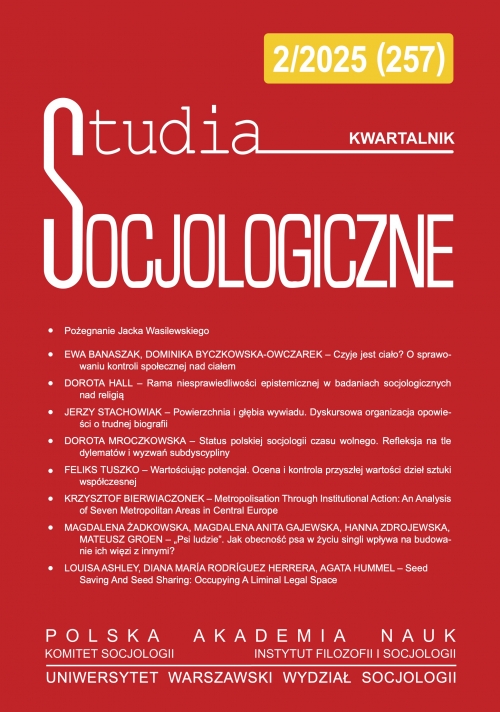
The Status of Polish Sociology of leisure. reflection on the Dilemmas and challenges of the Subdiscipline
DOI:
https://doi.org/10.24425/sts.2025.154898Keywords:
globalisation, reflexivity, sociology of leisure, subdiscipline crisis, experiencing leisureAbstract
The text analyses and reflects on the current state of Polish sociology of leisure. It aims at establishing the reasons why sociology of leisure in Poland ‘fades away’ from the realm of sociological explorations. For many years now, the themes, topics, or issues related to leisure have been addressed within various subdisciplines rather than through the sociology of leisure itself, which we read as a manifestation of the latter’s decline. In this article, the transformation of Western European sociology of leisure forms the context for examining the dilemmas faced by its Polish counterpart. The final section of the article outlines an analytical perspective for the sociology of leisure that considers the subjectivity of experience and allows to recognize the diverse forms, styles, and ways of experiencing leisure as well as its entanglement in the changing social context.
References
Aitchison, C. (2000). Poststructural Feminist Theories of Representing Others: A Response to the "Crisis" in Leisure Studies' Discourse. Leisure Studies, 19, 127-144. [https://doi.org/10.1080/02614360050023044](https://doi.org/10.1080/02614360050023044)
Aitchison, C. (2009). Exclusive Discourses: Leisure Studies and Disability. Leisure Studies, 28(4), 375-386. [https://doi.org/10.1080/02614360903125096](https://doi.org/10.1080/02614360903125096)
Beck, U., Giddens, A., Lash, S. (red.). (2009). Modernizacja refleksyjna. Polityka, tradycja i estetyka w porządku społecznym nowoczesności (J. Konieczny, tłum.). Wydawnictwo Naukowe PWN.
Beck, U., Beck-Gernsheim, E. (2013). Miłość na odległość. Modele życia w epосе globalnej (M. Sutowski, tłum.). Wydawnictwo Naukowe PWN.
Benett, A. (2005). Culture and Everyday Life. Sage Publications.
Best, S. (2010). Leisure Studies. Themes & Persectives. Sage Publications.
Blackshaw, T. (2014). The Crisis in Sociological Leisure Studies and What To Do about It. Annals of Leisure Research, 17(2), 27-144. [https://doi.org/10.1080/11745398.2014.920263](https://www.google.com/search?q=https://doi.org/10.1080/11745398.2014.920263)
Bilton, T., Bonnet, K., Jones, P., Skinner, D., Stanworth, M., Webster, E. (1999). Introductory Sociology. Macmillan.
Bloch, P.H., Bruce, D.G. (1984). Product Involvement As Leisure Behavior. W: T. C. Kinnear (red.), Provo UT: Advances in Consumer Research, 11, Association for Consumer Research, 197-202.
Bombol, M., Dąbrowska, A. (2003). Czas wolny, konsument, rynek, marketing. Wydawnictwo K.E. Liber.
Bukraba-Rylska, I., Burszta, W. (red.). (2011). Stan i zróżnicowanie kultury wsi i małych miast w Polsce. Kanon i rozproszenie. Narodowe Centrum Kultury.
Burdge, R. J. (1989). The Evolution of Leisure And Recreation Research from Multidisciplinary to Interdisciplinary. W: E. L. Jackson, T. L. Burton (red.), Understanding Leisure and Recreation: Mapping the Past, Charting the Future (s. 29-46). Venture Publishing.
Burton, T. L. (1980). The Maturation of Leisure Research. W: T. L. Goodale, Witt (red.), Recreation and Leisure: Issues in an Era of Change (s. 373-385). Venturing Publishing.
Bramham, P., Henry, I. O., Mommass, H., van der Poel, H. (red.). (1993). Policy Leisure Policies in Europe. University of Arizona Pres. [https://doi.org/10.1177/004728759403200367](https://www.google.com/search?q=https://doi.org/10.1177/004728759403200367)
Bramham, P. (2006). Hard and Disappearing Work, Making Sense of the Leisure Project. Leisure Studies, 4, 379-390. [https://doi.org/10.11080/02614360600896452](https://doi.org/10.11080/02614360600896452)
de Certeau, M. (2008). Wynaleźć codzienność. Sztuki działania (K. Thiel-Jańczuk, tłum.). Wydawnictwo Uniwersytetu Jagiellońskiego.
de Certeau, M., Giard, L., Mayol, P. (2011). Wynaleźć codzienność. 2. Mieszkać, gotować (K. Thiel-Jańczuk, tłum.). Wydawnictwo Uniwersytetu Jagiellońskiego.
Chick, G. (1997). Crossroads and Crises, or Much Ado About Nothing? A Comment on Mommaas and Coalter. Leisure Sciences, 19, 285-289. [https://doi.org/10.1080/01490409709512259](https://www.google.com/search?q=https://doi.org/10.1080/01490409709512259)
Clark, J., Critcher, C. (1985). The Devil Makes Work: Leisure in Capitalist Britain. University of Illinois Press.
Cushman, G., Veal, A. J., Zuzanek, J., (red.). (1996). World Leisure Participation: Free Time in the Global Village. CAB International.
Cushman, G., Veal, A. J., Zuzanek, J. (red.). (2005). Free Time and Leisure Participation. CABI Publishing.
Coalter, F. (1997). Leisure Sciences and Leisure Studies: Different Concept, Same Crisis? Leisure Sciences, 19, 255-268. [https://doi.org/10.1080/01490409709512254](https://doi.org/10.1080/01490409709512254)
Coalter, F. (1999). Leisure Science And Leisure Studies: The Challenge of Meaning. W: E. L. Jackson, T. L. Burton (red.), Leisure Studies: Prospects for the Twenty-First Century (s. 507-522). Venture Publishing.
Cook, D. T. (2006). Leisure and consumption. W: Ch. Rojek, S. M. Shaw, A. J. Veal (red.), Handbook of Leisure Studies. Palgrave Macmillan.
Critcher, C., Bramham, P., Tomlinson, A. (2001). Sociology of Leisure. Spon Press.
Critcher, C., Bramham, P. (2004). The Devil Still Makes Work. W: J. T. Haworth, A. J. Veal (red.), Work and Leisure. Routledge.
Cooper-Chen, A. (2003). Światowe zawody, rozrywka i czas wolny. Kobiety przed telewizorem. W: A. Gwóźdź (red.), Media eros - przemoc. Sport w czasach popkultury (s. 211-228). Universitas.
Csikszentmihalyi, M. (2005). Przepływ (M. Wajda-Kacmajor, tłum.). Biblioteka Moderatora.
Csikszentmihalyi, M., LeFevre, J. (1989). Optimal Experience in Work and Leisure, Journal of Personality and Social Psychology, 56(5), 815-822.
Dattilo, J., Murphy, W. D. (1991). Leisure Education Program Planning: A Systematic Approach. Venture Publishing.
Dattilo, J., Kleiber, D. A. (1993). Psychological Perspectives for Therapeutic Recreationresearch: The Psychology of Enjoyment. W: M. J. Malkin, C. Z. Howe (red.), Research in Therapeutic Recreation: Concepts and methods. Venture Publishing.
Deem, R. (1986). All Work and No Play? A Study of Women and Leisure. Open University Press.
Derengowski, J. (1932). Urlopy wypoczynkowe maszynistów kolejowych w świetle ankiety 1931 roku. Drukarnia L. Nowak.
Dobrowolska, D. (1963). Robotnicy na wczasach w pierwszych latach Polski Ludowej. Studia i materiały. Zakład Narodowy im. Ossolińskich, Wydawnictwo PAN.
Domański, H. (2000). Hierarchie i bariery społeczne w latach dziewięćdziesiątych. Wydawnictwo Instytut Spraw Publicznych.
Dumazedier, J., Latouche, N. (1962). Work and Leisure in French Sociology. A Journal of Economy and Society, 1, 13-30. [https://doi.org/10.1111/j.1468-232X.1962.tb00657.x](https://www.google.com/search?q=https://doi.org/10.1111/j.1468-232X.1962.tb00657.x)
Dumazedier, J. (1968). Some Remarks on Sociological Problems in Relation to Physical Education and Sports, International Review for the Sociology of Sport, 3, 5-16.
Driver, B. L., Brown, P. J. (1978). The Opportunity Spectrum Concept And Behavioral Infor-Mation in Outdor, Recreation Resource Supply Inventories: A Rationale. In Integrated Inven-teories of Renewable Natural Resources: Proceedings of the Workshop. USDA Forest Service Gen. Tech. Rep. RM-55, Fort Collins, CO: Rocky Mountain Forest and Range Experiment Station.
Gershuny, J. I. (1992). Change in the Domestic Division of Labour in the UK 1975 to 1987: Dependent Labour versus Adaptive Partnership. W: N. Abercrombie, A. Warde, Social Change in Modern Britain. Polity Press.
Giddens, A. (2001). Nowoczesność i tożsamość (J. A. Szulżycka, tłum.). Wydawnictwo Naukowe PWN.
Gliński, P., Siciński, A., Wyka, A. (1990). Społeczne aspekty ochrony i kształtowania środowiska w Polsce. Wydawnictwo SGGW-AR.
Godbey, G. (2008). Leisure in Your Life. New Perspectives. Venture Publishing.
Grad, J., Kaczmarek, U. (1999). Organizacja i upowszechnianie kultury w Polsce. Zmiany modelu. Wydawnictwo Naukowe UAM.
Gramsci, A. (1971). Selections from the Prison Notebooks. International Publishers.
Grotowska, S., Sroczyńska, M. (2023). Od „czasu wolnego" do „czasu niewolnego". Dylematy społeczeństwa osiągnięć. Studia Humanistyczne AGH, 22/1, 7-13. [https://doi.org/10.7494/human.2023.22.1.7](https://doi.org/10.7494/human.2023.22.1.7)
Habermas, J. (1975). Legitimation Crisis. Beacon Press.
Hemingway, J. L. (1995). Leisure Studies and Interpretive Inquiry. Leisure Studies, 14,32-47.
Hemingway, J. L. (1996). Emancipating Leisure: The Recovery of Freedom in Leisure. Journal of Leisure Research, 28(2), 27-43.
Henderson, K. A., Bialeschki, D., Shaw, S. M, Freysinger, V. J. (1989). A Leisure of One's Own: A Feminist Perspective on Women's Leisure. Venture Publishing.
Henderson, K. A., Shaw, S. (2006). Leisure and Gender: Challenges and Opportunities for Feminist Research. W: Ch. Rojek, S. Shaw, A. J. Veal (red.), A Handbook of Leisure Studies. Palgrave Macmillan Ltd.
Iso-Ahola, S. E. (1980). The Social Psychology of Leisure and Recreation. Brown Company Publishers.
Jacyno, M. (2012). Style życia. W: A. Giza, M. Sikorska (red.), Współczesne spoleczeństwo polskie. Wydawnictwo Naukowe PWN.
Jackson, E. L., Burton, T. L. (red.). (1999). Leisure Studies: Prospects for The Twenty-First Century. Venture Publishing.
Jagiełło-Łysiowa, E. (1961). Z badań nad zawodem rolnika. Studia Socjologiczne, 3, 212-221.
Jung, B. (1989). Ekonomia czasu wolnego. Zarys problematyki. PWN.
Jung, B. (2005). Poland. W: G. Cushman, A. J. Veal (red.), Free time and Leisure Participation. International Perspectives (s. 197-220). CABI Publishing.
Kono, S., Beniwal, A., Baweja, P., Spracklen, K. (red.). (2020) Positive Sociology of Leisure. Contemporary Perspectives. Palgrave Macmillan.
Kamiński, A. (1965). Czas wolny i jego problematyka społeczno-wychowawcza. Zakład Narodowy im. Ossolińskich.
Kelly, J. R. (1972). Work And Leisure: A Simplified Paradigm. Journal of Leisure Research, 4 (1), 50-62. [https://doi.org/10.1080/00222216.1972.11970057](https://doi.org/10.1080/00222216.1972.11970057)
Kelly, J. R. (1983). Leisure Identities and Interactions. George Allen and Unwin.
Kelly, J. R. (1987). Freedom to Be: A New Sociology of Leisure. Macmillan.
Kelly, J. R., Godbey, G. (1992). Sociology of leisure. Venture Publishing.
Kelly, J. R. (1996). Leisure. Allyn & Bacon.
Kelly, J. R. (1999). Leisure and Society: A Dialectical Analysis. W: E. L. Jackson, T. L. Burton (red.), Leisure Studies: Prospects for the Twenty-First Century (s. 53-70). Venture Publishing.
Kelly, J. R. (2012). Leisure as Life: Outline of a Poststructuralist Reconstruction. W: P.T. Zelaza, C.R. Veney (red.), Leisure in Urban Africa. Africa Word Press.
Kłoskowska, A. (1964). Kultura masowa. Krytyka i obrona. Państwowe Wydawnictwo Naukowe.
Kolny, B. (2016). Analiza czasu wolnego w budżecie czasu Polaków. Handel Wewnętrzny, 361(2), 228-240.
Korniłowicz, K. (1927). Wczasy młodzieży pracującej. Drukarnia Krajowa.
Kuhn, T. (1970). The Structure of Scientific Revolutions. University of Chicago Press.
Lash, S. (1991). The Culture of Narcissism. Norton.
Lynch, R.(1997). Whose Crisis at the Crossroads? Leisure Sciences, 19(4), 269-271.
Łaciak, B. (2009). Przyjemności i rozrywki jako wymiar współczesnej polskiej codzienności. W: M. Bogunia-Borowska (red.), Barwy codzienności. Analiza socjologiczna (s. 275-298). Wydawnictwo Naukowe Scholar.
MacLean, D.D. (1997). Kraus' Recreation and Leisure in Modern Society. Jones & Bartlett Publishers.
Mannel, R. C., Iso-Ahola, S. (1987). Psychological Nature of Leisure and Tourism Experience. Annals of Tourism Research, 14(3), 314-331
Mannell, R. C. (1999). Leisure Experience and Satisfaction. W: E.L.Jackson, T. L. Burton (red.), Leisure Studies: Prospects for the Twenty-First Century (s. 235-250). Venture Publishing
Martini, N. (2017). Praktykowanie czasu wolnego w sytuacji niedoboru i nadmiaru. Przegląd Socjologii Jakościowej, 4, 94-117. [https://doi.org/10.18778/1733-8069.13.4.06](https://www.google.com/search?q=https://doi.org/10.18778/1733-8069.13.4.06)
Mommas, H. (1997). European Leisure Studies at the Crossroads? A History of Leisure Research in Europe. Leisure Sciences, 19(4), 241-254. [https://doi.org/10.1080/01490409709512253](https://www.google.com/search?q=https://doi.org/10.1080/01490409709512253)
Mommas, H. (2003). European Leisure Studies at the Crossroads? Leisure Research and Leisure Policy in Europe. W: P. T. Zelaza, C. R.Veney (red.), Leisure in Urban Africa (s. 4-19). Africa World Press.
Morin, E. (2001). Kultura czasu wolnego. W: A. Mencwel (red.), Antropologia kultury. Zagadnienia i wybór tekstów, cz. 1. Wydawnictwo Uniwersytetu Warszawskiego.
MacCannel, D. (2003). Turysta. Nowa teoria klasy próżniaczej (E. Klekot, tłum.). Muza.
McLean, D. J. (1997). Response to Coalter: Understanding the "Meaningfulness" of Leisure. Leisure Sciences, 19, 273-275.
Muszyński, W. (red.). (2008a).,, Cudne manowce?". Kultura czasu wolnego we współczesnym społeczeństwie. Wydawnictwo Adam Marszałek.
Muszyński, W. (red.) (2008b).,, Czas ukoi nas?". Jakość życia i czas wolny we współczesnym społeczeństwie. Wydawnictwo Adam Marszałek.
Mroczkowska, D. (red.). 2011. Czas wolny. Refleksje, dylematy, perspektywy. Difin.
Mroczkowska, D. (2020). Zrozumieć czas wolny. Przeobrażenia, tożsamość, doświadczanie. Wydawnictwo Naukowe UAM.
Mroczkowska, D. (2023). Czas wolny o codziennych i (nie)codziennych scenariuszach doświadczania. Studia Humanistyczne AGH, 1(22), 13-32. [https://doi.org/10.7494/human.2023.22.1.13](https://www.google.com/search?q=https://doi.org/10.7494/human.2023.22.1.13)
Nowakowski, S. (1957). Czas wolny od pracy. Zagadnienia cywilizacji nowoczesnej. Konferencja Międzynarodowa w Annecy. Kultura i Społeczeństwo, 3, 187-190.
Olcoń-Kubicka, M., (2009). Indywidualizacja a nowe formy wspólnotowości. Wydawnictwo Naukowe Scholar.
Parr, M. G., Lashua, B. D. (2004). What Is Leisure? The Perceptions of Recreation Practioners and Others. Leisure Sciences, 26, 1-17. [https://doi.org/10.1080/01490400490272512](https://www.google.com/search?q=https://doi.org/10.1080/01490400490272512)
Pawełczyńska, A. (1961). Czas wolny mieszkańców miast. Studia Socjologiczne, 3, 226-233.
Pęczak, M. (2010). Co robimy po godzinach". W: W. J. Burszta (red.), Kultura miejska w Polsce z perspektywy interdyscyplinarnych badań jakościowych. Narodowe Centrum Kultury.
Pęczak, M. (2011). Nasze globalne wioski, czyli o tożsamości kulturowej i świadomości kulturalne. W: I. Bukraba-Rylska, W. Burszta (red.), Stan i zróżnicowanie kultury wsi i małych miast w Polsce. Kanon i rozproszenie. Narodowe Centrum Kultury.
Putnam, R. D. (2000). Bowling Alone: The Collapse and Revival of American Community. Simon & Schuster.
Prażmowska-Ivanka, W. (1937). Wczasy ludzi miasta. Instytut Spraw Społecznych.
Pronovost, G. (2000). The Collapse of the Leisure Society? New Challenges for the Sociology of Leisure. W: S. R. Quah, A. Sales (red.), The International Handbook of Sociology (s. 356-367). Sage Publications.
Roberts, K. (1999). Leisure in Contemporary Society. CABI Publishing.
Roberts, K. (2004). The Leisure Industries. Macmillan.
Roberts, K. (2013). Leisure in the West after the End of the Long Baby Boomer Generation. W: L. V. Massimo, M. Cappello (red.), Mapping Leisure across Borders (s. 2-20). Cambridge Scholars Publishing.
Rojek, Ch. (1985). Capitalism And Leisure Theory. Tavistock Publications
Rojek, Ch. (1995). Decentring Leisure. Rethinking Leisure Theory. Sage Publications.
Rojek, Ch. (2005). Leisure Theory. Principles and Practice. Palgrave Macmillan.
Rojek, Ch., Shaw, S., Veal, A. J. (red). (2006). A Handbook of Leisure Studies. Palgrave Macmillan.
Rojek, Ch. (2010). The Labour of Leisure. Sage Publications.
Rowe, D., Lawrence, G. (1997). The Australian Canon in Leisure, Tourism and Sport Studies. W: D. Rowe, P. Brown (red.), Leisure: People, Places, Spaces. Proceedings of the Australian and New Zealand Leisure Studies Association (s. 184-189). The University of Newcastle.
Rowe, D. (2002). Producing the Crisis: The State of Leisure Studies. Annals of Leisure Research, 5(1), 1-13. [https://doi.org/10.1080/11745398.2002.10600895](https://doi.org/10.1080/11745398.2002.10600895).
Rowe, D. (2006). Leisure, Mass Comminicationa and Media. W: Ch. Rojek, S. Shaw, A. J. Veal (red.), A Handbook of Leisure Studies (s. 317-334). Palgrave Macmillan.
Shaw, S. M. (1997). Cultural Determination, Diversity, and Coalition in Leisure Research: A Commentary on Coalter and Mommas. Leisure Sciences, 19, 277-292.
Shaw, S. M. (1999). Gender and leisure. W: E. L. Jackson, T. L. Burton (red.), Leisure Studies: Prospect for the Twenty - First Century. Venture Publishing.
Stebbins, R. A. (1997). Meaning, Fragmentation, and Exploration: Bête Noire of Leisure Science. Leisure Sciences, 19, 281-284. [https://doi.org/10.1080/01490409709512258](https://www.google.com/search?q=https://doi.org/10.1080/01490409709512258)
Stephen, C., Pakulski, J., Waters, M. (1992). Postmodernization: Change in Advanced Society. Sage Publications.
Shintaro, K., Beniwal, A., Baweja, P., Spracklen, K. (red). (2020). Positive Sociology of Leisure. Contemporary Perspectives. Palgrave Macmillan.
Sieradzki, P. (2011). Gerharda Schulze teoria społeczeństwa doznań. Wydawnictwo Adam Marszałek.
Siciński, A., Wyka, A. (1988). Badania, rozumiejące" stylu życia. Narzędzia. Wydawnictwo IFiS PAN.
Siciński, A. (red.) (1988). Style życia w miastach polskich (u progu kryzysu). Wydawnictwo PAN.
Siciński, A. (2002). Styl życia, kultura, wybór. Wydawnictwo IFIS PAN.
Skórzyński, Z. (1961). Zajęcia czasu wolnego ludności miejskiej. Biuletyn OBОР.
Skórzyński, Z. (1965). Między pracą a wypoczynkiem. Czas „zajęty" i czas wolny" mieszkańców miast w świetle badań empirycznych. Zakład Narodowy im. Ossolińskich.
Skórzyński, Z., Ziemilski, A. (1971). Wzory społeczne wakacji w Polsce. Instytut Naukowy Kultury Fizycznej.
Sułkowski, B. (1976). Zabawa - studium socjologiczne. PWN.
Sułkowski, B. (1998). Czas wolny. W: Encyklopedia Socjologii, t. 1. Oficyna Naukowa.
Sułkowski, B. (2001). Jak wypoczywamy, jak się bawimy. W: W. Kuczyński (red.), Księga. Dziesięciolecie Polski Niepodległej 1989-1999. United Publishers & Productions.
Stebbins, R. (2007). Serious Leisure. A Perspective for Our Time. Transaction Publisher.
Strzemińska, H. (1988). Czas pracy i czas wolny w polityce społecznej. Państwowe Wydawnictwo Ekonomiczne.
Szlendak, T. (2009). Co się dzieje z czasem wolnym? Od codziennego znoju i odpoczynku do codzienności, w której czas eksplodował. W: M. Bogunia-Borowska (red.), Barwy codzienności. Analiza socjologiczna (s. 201-214). Wydawnictwo Naukowe Scholar.
Szlendak, T. (2011). Nic? Aktywność kulturalna na wsi i w małych miastach. W: I. Bukraba-Rylska, W. J. Burszta (red.), Stan i zróżnicowanie kultury wsi i małych miast w Polsce. Kanon i rozproszenie (s. 53-102). Narodowe Centrum Kultury.
Tanaś, W., Welskop, W. (red.). (2016). Kultura czasu wolnego we współczesnym świecie. Wydawnictwo Naukowe Wyższej Szkoły Biznesu i Nauk o Zdrowiu.
Tarkowska, E. (2001a). Czas społeczny a czas wolny: koncepcje i współczesne przemiany. W: A. Żarnowska, A. Szwarc (red.), Kobieta i kultura czasu wolnego (s. 17-33). DiG.
Tarkowska, E. (2001b). Czas a cywilizacja przyszłości. Na marginesie ludzi teraźniejszych, W: M. Ziółkowski (red.), Ludzie przełomu tysiąclecia a cywilizacja przyszłości (s. 7-13). Wydawnictwo Fundacji Humaniora.
Tarkowska, E. (2009). Perspektywa interdyscyplinarna w badaniach stylów życia. W: P. Gliński, A. Kościański (red.), Siciński i Socjologia (s. 135-147). Wydawnictwo IFIS PAN.
Toti, G., 1963, Czas wolny. Warszawa.
Truszkowska-Wojtkowiak, M. (2012). Fenomen czasu wolnego. Harmonia Universalis.
Urry, J. (2007). Spojrzenie turysty (A. Sulżycka, tłum.). Wydawnictwo Naukowe PWN.
Veal, A. (1992). Definitions of Leisure and Recreation. Australian Journal of Leisure and Recreation, 4, 44-52.
Veal, A. J., Lynch, R. (2001). Australian Leisure. Longman.
Veal, A. J. (2002). Leisure Studies at the Millennium: Intellectual Crisis or Mature Complacency? Journal of Hospitality and Tourism Management, 9(1), 37-45.
Veal, A. J. (2009). The Elusive Leisure Society. University of Technology.
Watkins, M. (2000), Ways of Learning about Leisure Meanings. Leisure Sciences, 22, 93-100. [https://doi.org/10.1080/014904000272876](https://doi.org/10.1080/014904000272876)
Wnuk-Lipiński, E. (1971). Gospodarowanie czasem wolnym i zajętym. GUS.
Wnuk-Lipiński, E. (1972). Praca i wypoczynek w budżecie czasu. Wydawnictwo IFiS PAN.
Wnuk-Lipiński, E. (1981). Budżet czasu struktura społeczna-polityka społeczna. Wydawnictwo IFIS PAN.
Williams, R. D. (1997). Introduction to Theme Issue, Leisure Scienes, 19(4), 239-240. [https://doi.org/10.1080/01490409709512252](https://doi.org/10.1080/01490409709512252)
Zacharzewska, S. (1931). Urlopy wypoczynkowe pracowników drukarskich w świetle ankiety 1930 roku. Instytut Gospodarstwa Społecznego.
Downloads
Published
How to Cite
Issue
Section
License
Copyright (c) 2025 Studia Socjologiczne

This work is licensed under a Creative Commons Attribution-NonCommercial-NoDerivatives 4.0 International License.